Showing posts with label SUNDAY SIMPLICITIES. Show all posts

Sunday, January 30, 2011

RURAL DAY OF 58 DEGREES AND SUNSHINE


At last the sun is shining here in Central Kentucky and the temptures rose to an unbeliable 58 degree Fahrenheit. When I was growing up in Michigan we would call this the January thaw.


Spent the day outside and took a few photos. One is the old barn above with its vote for Holt for sheriff. No I don't know Holt. Notice the clear blue sky -- haven't seen one for weeks.


A perfect ending to the lovely day was this wonderful sunset seen from my front porch. I hope you are having a good weekend wherever you are.

Sunday, December 26, 2010

WALKING IN A WINTER WONDERLAND -- SUNDAY SIMPLICITIES

MY OLD BARN BEING SHOWERED WITH SNOW FLAKES

SAL INVESTIGATING SMELLS AT THE PASTURE GATE 

OLD LIL WALKING WITH ME SLOWLY -- LOVING THE SNOW

OAK LEAVES WITH A PATCHWORK OF SNOW

Saturday, September 25, 2010

FOLK VERNACULAR ARCHITECTURAL FRAGMENTS -- Sunday Simplicities

Folk architectural fragments, vernacular in feeling, that I found in Madison, Mason, and Garrard Counties of Kentucky

Backside of smokehouse -- Madison County


Limestone entrance stairs to early 1800s house -- Garrard County


Deteriorating gingerbread trim -- Garrard County

Entrance Door to old business place -- Mason County

Saturday, September 4, 2010

CREPE PAPER, PARADES AND LABOR DAY -- Sunday Simplicities


PROBABLY 40s SMALL TOWN PARADE
When I think of Labor Day visions of small town parades come into my head. I was raised in what was then a small town and I guess it still would be considered a small town had it has not been swallowed up by nearby growth, giving it the appearance today of being a larger whole. 

On Monday we will celebrate our federal holiday -- Labor Day -- established so in 1884 although its beginning really began in 1882. It came about thorough the labor union movement advocating for an 8 hour work day -- its proposal for a federal labor holiday said that there should be a parade to exhibit the strength and spirit of trade and labor unions. Thus, began the pattern of our Labor Day celebrations. 

MY BIKE AND I DECORATED IN CREPE PAPER
BEFORE THE PARADE
The photo at the top of this post was probably taken in one of the many small towns of our country in the 1940s. I picked up the photo in my wanderings through second hand stores -- looking for old photos and ephemera. Although I can't say it is a Labor Day parade -- it is similar -- lots of crepe paper decorating floats and trucks. I believe it is a forties photo as the women are in slacks probably a result of the WWII Rosie the Riveter influence. And, the fact that the cars along the side street were made in the 30s -- it was tough to get new model cars in the 40s because metals were needed for the war effort. Also, it was probably a small town as the crowds along the sidewalk are minimal. 

In this top photo we have the typical material used in parades to decorate floats, trucks, cars, and even people -- crepe paper. Crepe was a light weight paper that could be bought in either rolls or sheets in all colors. This material was great to twist and turn around vehicles in Labor Day parades. 

THE PARADE I RODE IN WITH THE COMMUNITY ATTENDING
I was subject to my mother's addiction for crepe paper decorating.. With love in her heart she produced a crepe paper dress for me to wear in our small town 40s parade and even decorated my bike  in matching colors with the paper.  I think the colors were red, white and blue if I remember correctly. But as a child I loved the dress and rode in the parade with a smile. 

The photo above is the parade I rode in. Children were encouraged to participate in the parade as well as citizens, organizations and politicians. It was a gathering of community for the small town. 

And why do I remember parades so fondly -- because I won a prize for being the best decorated person in the children's part of the parade -- thanks to my mom!

Have a good Labor Day everyone!

Saturday, August 21, 2010

VITALITY FOUND IN SMALL TOWN --Sunday Simplicities

FIDDLER AT THE CELTIC
FESTIVAL
I have written about the struggles that small towns have faced  trying to realize a viable commercial/retail main street. They face tough odds as box stores proliferate at the edges of their old commercial centers or perhaps businesses just up and leave altogether requiring a drive of several miles to buy even a common light bulb or similar small items. 

However, some small towns have found the magic key to staying alive and viable. One such town is Berea, Kentucky -- it 
has been able to maintain an energetic economy while retaining its old commercial centers. My photos in this post show some examples of attributes.


LANDSCAPE PODS ALONG MAIN STREET
After I took early retirement, I worked at different short term positions. One was helping small towns revitalize. I offered grant and historic preservation consulting. Working with these towns made me aware of the problems they were trying to head off. It seemed a no-win situation at times. I learned as much from the people of these towns as they learned from me. 


WELL MAINTAINED BUILDINGS
 ALONG WITH VIBRANT
 PLANT CONTAINERS ALONG
 MAIN STREET
What does Berea do that keeps the energy flowing, I'll mention what I have observed as a visitor to the town. They do have a few things in place that certainly helps the town stem the tide of gloom and doom of other small towns. One, they have Berea College, a nationally known liberal small college.Two, they established the area as a recognized arts community. Three, they maintain their physical assets such as commercial buildings, parking and streets. And four, they bring to the town on a very regular basis, lecturers, music, festivals, and other events that encourage citizen participation as well as tourists.


FULL TIME STAFFING
 TO MAINTAIN
 STREET PLANTINGS


Granted, not all small towns have the money or organization to bring their towns back from obscurity but perhaps taking it step by step in the right direction  can result in  being a viable town for the community. 


INVITING BACK SIDES OF
COMMERCIAL BUILDINGS


Small town revitalization is a large issue that cannot be addressed in this small post but I believe it can be done over time with active town citizens


Saturday, July 10, 2010

DEATH STANDS IN THE SHADOWS FOR BEES, BATS, AND POLLINATORS -- Sunday Simplicities

BUMBLEBEE VISITING MY COSMOS

Pollinators, especially bees, are what pioneering environmentalist Rachel Carson called a keystone species. Remove the keystones and the whole edifice collapses.

Here is a partial list of our pollinators -- hummingbirds, bats, butterflies, sweat bees, carpenter bees, mason bees, bumblebees and honeybees. (The New Internationalist)

DEATH FOR A BUMBLEBEE

Last week I found this dead bee wholly intact and in perfect condition. It was lying on my front porch. I moved the bee to a better observation level and wondered what made this bee just collapse? I am sure many factors could contribute to the death of this bee. But it made me think of the Colony Collapse Disorder (CDD) that was discovered in 2006.

I searched online for some possible answers. Some bees are thought to be declining from loss of habitat, industrial farming, and the use of herbicides and pesticides. The pesticide neonicotinoids made by the German company Bayer is approved for 140 crops in 100 plus countries. The pesticide disrupts the bees nervous system. It has special bans in France and the UK. Also, hives travel on trucks to pollinate orchard after orchard for commercial crop production causing stress within the hives.

The USDA acknowledges that pesticides are part of the reason for CDD. Yet, pesticides are still used on crops here in the U.S. There is no ban on neonicotinoids use here in the good ole U.S. of A.
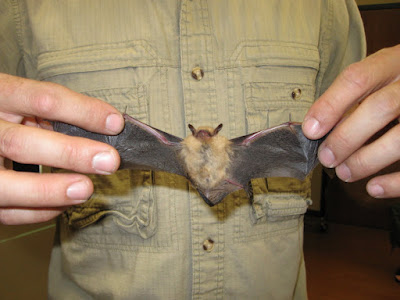
HEALTHY EASTERN PIPSTERELLE BAT FOUND IN KENTUCKY

Carson's warning about the serious results of pollinator decline appears to be in the works in this country. Many pollinators are now experimenting decline. A more succinct word for decline is death.

In 2006-2007 bats were discovered to be dying at a rapid pace from what appeared to be fungus related. Experts have dubbed the fungus the white nose syndrome (WNS). Not all scientists agree that the fungus is the problem. Bats are critical to the control of much of our insects that destroy our crops as well as the control of mosquito populations.

WNS has spread from New York to some places in Canada as well as eight other states. Mortality rate from the WNS is close to 100 percent. Scientists do not have a clue as to the reason this unknown fungus is perhaps killing the bats. Some research is being conducted to identify and halt its spread but as of yet nothing has surfaced to help the situation. To me, it appears that we need more researchers.

I find it interesting that both CDD and WNS appeared in 2006 here in the U.S.

I predict that more pesticides will come into use as a result of the loss of our bats. And where would that lead us?


BUTTERFLY COLLECTING NECTAR ON MY 2009 ZINNIAS

Great changes would occur through the loss of our pollinators. Changes to the natural world as well as to our sense of nature.

I have just touched on a part of this disaster of the wholesale decline of pollinators. I have listed below some informative sites that you should check out.


USGS National Wildlife Center -- excellent site -- includes the WNS Occurrence by County map for both Canada and the U.S.

The New Internationalist Article -- Why are Bees Dying

WORLD CHANGING Good article about bee decline research

Field and Stream I am not a hunter but thought this article worth reading. Discusses the crucial symbiotic relationship between birds and bees -- also has very informative comments from readers.

And last but not least is an insightful book, The Forgotten Pollinators by Stephen L. Buchmann and Gary Paul Nabhan -- an important book to read if you are interested in the subject.

Saturday, June 5, 2010

THOUSANDS OF FIREFLIES FLASHING -- SUNDAY SIMPLICITIES

SYNCHRONOUS FIREFLY FLASHING, DIFFICULT TO SEE, LOOK FOR TINY WHITE LIGHTS
fLICKR PHOTO:
dckf_$êr@pH!nX's

On the first evening of June about 10 PM I was letting my dogs out the front door for their last call.. I usually let them out the back but this night I was being lazy and knew the front door would be quicker. As I opened the door I was greeted with a spectacular phenomenon the likes of which I had never seen before in my life.

I live on a ridge of Bear Mountain and have a surround view of the mountains up to their tops and also a narrow low-lying, flatland fissure that runs below which they call a holler in Kentucky. What I quickly saw in front of me was a light show of thousands of fireflies (lightning bugs) flashing all along the holler below rising upward to the tops of the surrounding mountains. I slowly stepped outside completely in awe of such a remarkable display. I sat watching for about fifteen or twenty minuets, then bid the fireflies goodnight telling them that I would be back tomorrow.

SAL, MR CURIOUS, SITS ON THE PORCH HELPING ME WATCH FOR FIREFLIES

The next evening, I sat on my front porch during the same time and place as last night, but no thousands of fireflies? Fireflies yes, it was the usual number that I see at this time every year. Then I went out again the following couple nights, same time, same place, and again only saw the usual amount of flickering firefly lights. Nothing to even come close to what I saw on that first evening in June. I scratched my head and wondered what type of occurrence had happened on that first night when so many fireflies were flashing like small twinkle lights all up and down the valley heights?

WE SPOT A COUPLE FIREFLIES ON SUBSEQUENT NIGHTS.

Yesterday I received my June/July issue of National Wildlife Magazine and there was an article about fireflies, Photinus carolinus, and their synchronized flashing -- flashing by the thousands. These occurrences were mentioned as happening in the Great Smokey Mountains in June around 9PM to 10PM. Could this be a similar event that I witnessed?

The magazine described the incredible flashing display as starting out in the dozens, expanding to the hundreds and then into the thousands.They flash together for 4 seconds then pause10 to 12 seconds. The flashing is actually a way for males and females to connect to each other -- it's their "come hither" flash that promotes the species.

Perhaps it's a once in a lifetime occurrence for someone like myself to observe? No matter if it was a flashing synchronous firefly show or some wonder of the cosmos, to me it appeared as another of nature's beautiful mysteries.