Showing posts with label ANIMALS. Show all posts

Saturday, February 15, 2014

SURVIVING THE WINTER STORMS


Our rain storm today, swiftly blowing out to the west this evening


We are quite fortunate in Washington state, weather wise that is, compared to the Northeast part of the United States. I have been listening for days to the weather folks explaining the huge storms that have been hitting the eastern portion of the U.S. Tonight I read some of the blogs that are located in the snowy part of our country and shudder to think what they are going through.

 On the blog Slow Cook I read how they lost power last night for a few hours and when morning breaks they have to get out to the barn to feed and care for their farm animals -- trudging through cold temps and very deep snow! At the time of my reading they could not get out of their drive as their truck was stuck there.

Tabor over at Room Without Walls writes about the flocks of birds fighting over the food available from her feeder. They are fighting for survival she feels. She has photos of all the birds at her feeders.

It has been a tough winter for not only many humans but also the wild critters. I give thanks to the folks out there that are having a tough time getting around but still can find time to care for the animals, both wild and domestic.


Monday, November 21, 2011

OCCUPY NATURE -- THANKSGIVING TRUCE


Here is the table I wish I was at for Thanksgiving. One that gave thanks to all of nature with its animate spirit (including turkeys) . I found this print at the Library of Congress. Of course you recognize the toast master -- Theodore Roosevelt, our former President and a well-renown conservationist. He was responsible for saving many of our wild lands that we enjoy today -- such as:


Crater Lake, Oregon
Wind Cave, South Dakota
Sullys Hill, North Dakota
Mesa Verde, Colorado
 Chickasaw National Recreation Area, Oklahoma 


Plus other National Park areas like part of the Grand Canyon.


My wish for Thanksgiving is that these areas will continue to be protected from corporate and political greed so that my grandchildren will be able to sit at a table in the wild just like Teddy did with his animal friends above.


Happy Thanksgiving


Saturday, July 10, 2010

DEATH STANDS IN THE SHADOWS FOR BEES, BATS, AND POLLINATORS -- Sunday Simplicities

BUMBLEBEE VISITING MY COSMOS

Pollinators, especially bees, are what pioneering environmentalist Rachel Carson called a keystone species. Remove the keystones and the whole edifice collapses.

Here is a partial list of our pollinators -- hummingbirds, bats, butterflies, sweat bees, carpenter bees, mason bees, bumblebees and honeybees. (The New Internationalist)

DEATH FOR A BUMBLEBEE

Last week I found this dead bee wholly intact and in perfect condition. It was lying on my front porch. I moved the bee to a better observation level and wondered what made this bee just collapse? I am sure many factors could contribute to the death of this bee. But it made me think of the Colony Collapse Disorder (CDD) that was discovered in 2006.

I searched online for some possible answers. Some bees are thought to be declining from loss of habitat, industrial farming, and the use of herbicides and pesticides. The pesticide neonicotinoids made by the German company Bayer is approved for 140 crops in 100 plus countries. The pesticide disrupts the bees nervous system. It has special bans in France and the UK. Also, hives travel on trucks to pollinate orchard after orchard for commercial crop production causing stress within the hives.

The USDA acknowledges that pesticides are part of the reason for CDD. Yet, pesticides are still used on crops here in the U.S. There is no ban on neonicotinoids use here in the good ole U.S. of A.
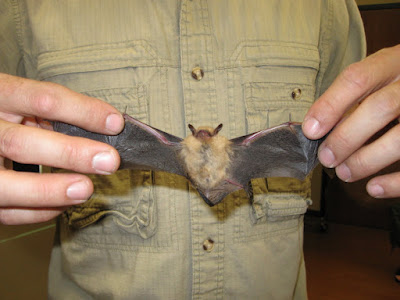
HEALTHY EASTERN PIPSTERELLE BAT FOUND IN KENTUCKY

Carson's warning about the serious results of pollinator decline appears to be in the works in this country. Many pollinators are now experimenting decline. A more succinct word for decline is death.

In 2006-2007 bats were discovered to be dying at a rapid pace from what appeared to be fungus related. Experts have dubbed the fungus the white nose syndrome (WNS). Not all scientists agree that the fungus is the problem. Bats are critical to the control of much of our insects that destroy our crops as well as the control of mosquito populations.

WNS has spread from New York to some places in Canada as well as eight other states. Mortality rate from the WNS is close to 100 percent. Scientists do not have a clue as to the reason this unknown fungus is perhaps killing the bats. Some research is being conducted to identify and halt its spread but as of yet nothing has surfaced to help the situation. To me, it appears that we need more researchers.

I find it interesting that both CDD and WNS appeared in 2006 here in the U.S.

I predict that more pesticides will come into use as a result of the loss of our bats. And where would that lead us?


BUTTERFLY COLLECTING NECTAR ON MY 2009 ZINNIAS

Great changes would occur through the loss of our pollinators. Changes to the natural world as well as to our sense of nature.

I have just touched on a part of this disaster of the wholesale decline of pollinators. I have listed below some informative sites that you should check out.


USGS National Wildlife Center -- excellent site -- includes the WNS Occurrence by County map for both Canada and the U.S.

The New Internationalist Article -- Why are Bees Dying

WORLD CHANGING Good article about bee decline research

Field and Stream I am not a hunter but thought this article worth reading. Discusses the crucial symbiotic relationship between birds and bees -- also has very informative comments from readers.

And last but not least is an insightful book, The Forgotten Pollinators by Stephen L. Buchmann and Gary Paul Nabhan -- an important book to read if you are interested in the subject.

Thursday, July 1, 2010

OLD APPLE CRABAPPLE TREE ON VERNACULAR HOMESITE

When I was walking along the sidewalk of a small town, taking photos of an early Lancaster, Kentucky house, I noticed this tree in the front yard -- its apples were all over the ground and had spilled its fruit out to the sidewalk and beyond into the street. Hundreds of the same size small apple.

This pattern of so many dropped apples brought back memories of the old crabapple trees of my youth. I rarely see these types of trees anymore. Only around older houses or homesteads.

I did some research online about crabapples. I found that if they are used for fruit production they are called apple crabapple trees. If they are used for ornamental flowering they are called flowering crabapples.

I believe that I do not see many of the old apple type any more because folks just don't bake and cook like they used too. Its lost its stature as an important part of household food. Also, I believe that the extensive fall of the small apples would be looked upon as messy in today's culture. Gotta keep those lawns neat and tidy.

The apple crabapple tree provides fruit for jam, jellies, cider, spicing up sauces, pickles and probably other uses that were not listed online.

Here is the definition of an apple crabapple tree provided by TreeHelp.com:

Crabapples are differentiated from apples based on fruit size. If the fruit is larger than two inches it is classified as an apple. Fruit is borne in the summer and fall. Colors range from dark-reddish purples through the reds and oranges to golden yellow and even some green. On certain selections the fruit can remain attractive well into the late winter. The larger fruited cultivars offer a bonus because the fruit can be spiced or used in jelly.

Here is the front view of the early house where I found the tree. It has had some updating over the many years of its existence.

I will venture to say that the architectural trim around the porch was added sometime before the 1900s. New storms or windows were added some 30 years ago. The outdated landscape bushes look like from the 40s or 50s. The house is fairly devoid of any mature landscaping other than an old hydrangea bush and the old crabapple tree. Perhaps at some point within the last 50 or 60 years there began a landscaping shift toward the barren look that seems to be still popular with many today.

A shot of the northwest front corner of the lovely early brick house appears to be in good shape structurally.

This close-up shot shows an original Federal type light (window) over the front door. This would date the house pre 1850. Usually Federal front doors also had side lights as well as a light over the door. But, this house would fall in the vernacular architecture type so therefore it was built simply incorporating only some of the styles of the time.

Now getting back to the lovely old crabapple in the front yard. I thought about the fruit laying on the ground. Luckily birds and some mammals will find these apples a treat, especially as they ferment. The tree apparently is in mid-age of its projected 70 year life. It has some producing years left. Surely it will produce memories to children passing by -- like the memories I have from long ago. So now the tree is for wildlife and children only. But that is OK.
*****

The Appalachian town of Lancaster, Kentucky was founded in 1797 and in 2008 the population was 4,403.

Saturday, June 12, 2010

EASTERN PHOEBE --- LIFE AND DEATH -- Sunday Simplicities

Female Eastern Phoebe Nesting on My Porch

A few hours ago an Eastern Phoebe chick fell to its demise apparently from its nest. It landed on my cement porch. A sad occasion for the parents as well as for me. I had watched the parents from the start -- selecting the site on the top of one of my porch columns -- building the nest- sitting on the eggs to keep them warm, and nourishing them with food once they hatched.

Here is how I discovered what had happened. I heard the Phoebe's urgent distress calls outside my door. I thought some critter was disturbing the nest. When I looked outside the door -- there on the porch was a well developed little bird, not alive. I had been out on the porch about 15 minutes before this disturbance was set off. Apparently, I deduce, it happened right after I went back inside.

For the past three hours the parents have been circling the area constantly crying fee-bee and making a rapid clicking sound. A few times flying to the empty nest, perching on the edge and looking downward into the nest. A nest that was now empty.

I had seen one other baby in the nest -- perhaps he/she fledged and this one just didn't have the wing power when he/she fledged.

The parent's are acting very stressed. And why shouldn't they be. All that love and care they had given their brood.

We are all connected -- no one can tell me differently. Emotions are within all animals. Although, many will disagree, I recognize grief and that is what I saw and heard today.

And as I say these words above, I think of the wildlife of the Gulf of Mexico. In my heart the grief that is emanating from its wildlife is numbing and overwhelming.

Saturday, May 1, 2010

OIL, WETLANDS, OCEAN, BP -- SUNDAY SIMPLICITIES

DEEPWATER HORIZON OIL PLATFORM -- A TRAGEDY FOR LIFE
source: Wikipedia

This event is not a simple one but a very complex one.

It is said that a picture is worth a thousand words. Well, below, I have several online photos of species that inhibit the coastal waters and wetlands of the Deepwater area. They are species photos, pre-Deepwater explosion. Now the area is filling fast with oil slick. We are beginning to see the oil slicked bodies of these species. I am personally sick over the whole event. I will say one thing; we need to go on an oil diet and put the pinch on the oil companies. I could say a lot more but I will let the species, through their photos, talk to you and maybe you all can figure out how to resolve this oil madness.

BROWN PELICAN RECENTLY TAKEN OFF THE ENDANGERED LIST
source: Wikipedia -- Alan D. Wilson

GREAT EGRETS WADING
source: Wikipedia

GREAT EGRET WITH CHICKS IN NEST
source: Wikipedia

RACOON WITH A DESTINATION
source: Rebecka Jackson

ROSEATE SPOONBILL IN FLIGHT
source: wikipedia

ROSEATE SPOONBILL WITH CHICKS IN NEST
source wikipedia

OSPREY WITH CATCH
source: wikipedia

LOGGERHEAD TURTLE -- ENDANGERED
source: wiki

BALD EAGLE IN FLIGHT
source: Anne D. Wilson

BALD EAGLE WITH CHICKS IN NEST
source: wiki

Sunday, April 4, 2010

FARM HORSE POWER

Times have changed. We have gone from traditional farming with draft horses to farming with trucks, tractors and assorted other engine vehicles. Draft horse power was converted into a form of measurement for the original engines of the newly developed steam ships and ultimately cars. trucks and tractors.

Over the past year, I have rode by this old truck parked along side of an abandoned building. It caught my eye originally by the huge white grill which spelled out the large letters -- GMC. I am a bit sentimental about old GM trucks as my father worked for General Motors Corporation's truck and coach division for 36 years in Michigan.

So that is what caught my eye at first. Then the license came next. It was registered, "farm," on its license plate. Then I realized it was a dump truck. The probably 70s truck, spelled out hard work -- which would be farm work by its designated license.

Nature, time, and people had beautified this dump truck. Like an old antique it had a patina of use and character. Above is a metal step up to the passenger side. Beat up for sure but still sturdy.

Now here is what I thought seemed like a modern painting. Rust had designed a pattern all over its dump section. It would take years for nature to oxidize this look.

Don't know who owns this beauty. I find its working scars a tribute to its many years of service. Years of good service due to a company that was proud of its trucks back when my father worked for GM.

Traditional farming changed when real horse power was converted to engine horse power.

But there is still one thing a truck or tractor can't do, but a draft horse can-- get in the fields to work when there is mud. Win some, lose some.

Saturday, January 30, 2010

WAYNE'S FOLK CARVINGS

SELF PORTRAIT

"The animals are inside the wood -- I go in and find them and bring them out.” Folk artist Wayne Wolfinger was holding a large section of a cutoff tree limb as he spoke these words. Wayne carves with a chain-saw releasing from the wood full-bodied folksy animals. He also, for the past twenty years, has designed folk metal pieces but his true calling is his wood pieces. He began this interlude with wood when he retired from the auto industry in Lansing, Michigan.

PART OF WAYNE'S GALLERY OF CARVINGS

Now 74 years of age, Wayne has created a gallery of animals around his home. His spark came when he viewed a chainsaw carving at an art show. That influential carving has resulted in a yard full of exuberant animals roaming across and through his vegetable and flower gardens. He has absolutely no desire to sell his work. He has feelings wrapped up in each piece and would not part with any of them. He has plenty of wood available from tree stumps on his large urban yard. To Wayne, the stumps are just the thing to turn into a standing bear, turtle or other folk art animal.

PENGUIN

Perhaps his love of nature also influenced his work when he started ten years ago. He creates his animals in an outdoor area behind his home. Wayne succinctly says "the wood directs what is to be made - then look for a photo of an animal to fit it - sketch it on paper and start to work". So with walnut, cypress, ash, and maple Wayne has taken his chainsaw and released characters to play in his yard.

Wayne and his wife lived winters in Florida for a while when he retired. While there he brought home cypress to carve. Some of his animals are therefore Floridians at heart.

TURTLE CARVED AS ONE WHOLE PIECE FROM A STUMP

Wayne spoke gently as we rounded his yard filled with various types of gardens. There was obvious delight in his voice as he told me about what he had created here. "The first one I did was the hoot owl on top of the grape arbor,” and, “it turned out so good that I couldn't quit." He explained that once he started making the animals "he just couldn't stop". He paints them with spray paint or any paint he has laying about -- ever so often he repaints them as they weather.


WAYNE'S WATCH DOG

Wayne is right when he says he can't quit carving. He is now preparing for his next project. Wayne pointed out a tree stump about five feet high. With it he is planning to carve the upper part into a goshawk. And, of course, after that project he is already thinking about the next -- a nice totem for another tall stump on his property.


BEAVER FROM A STUMP

BEAR FROM A TALL STUMP